


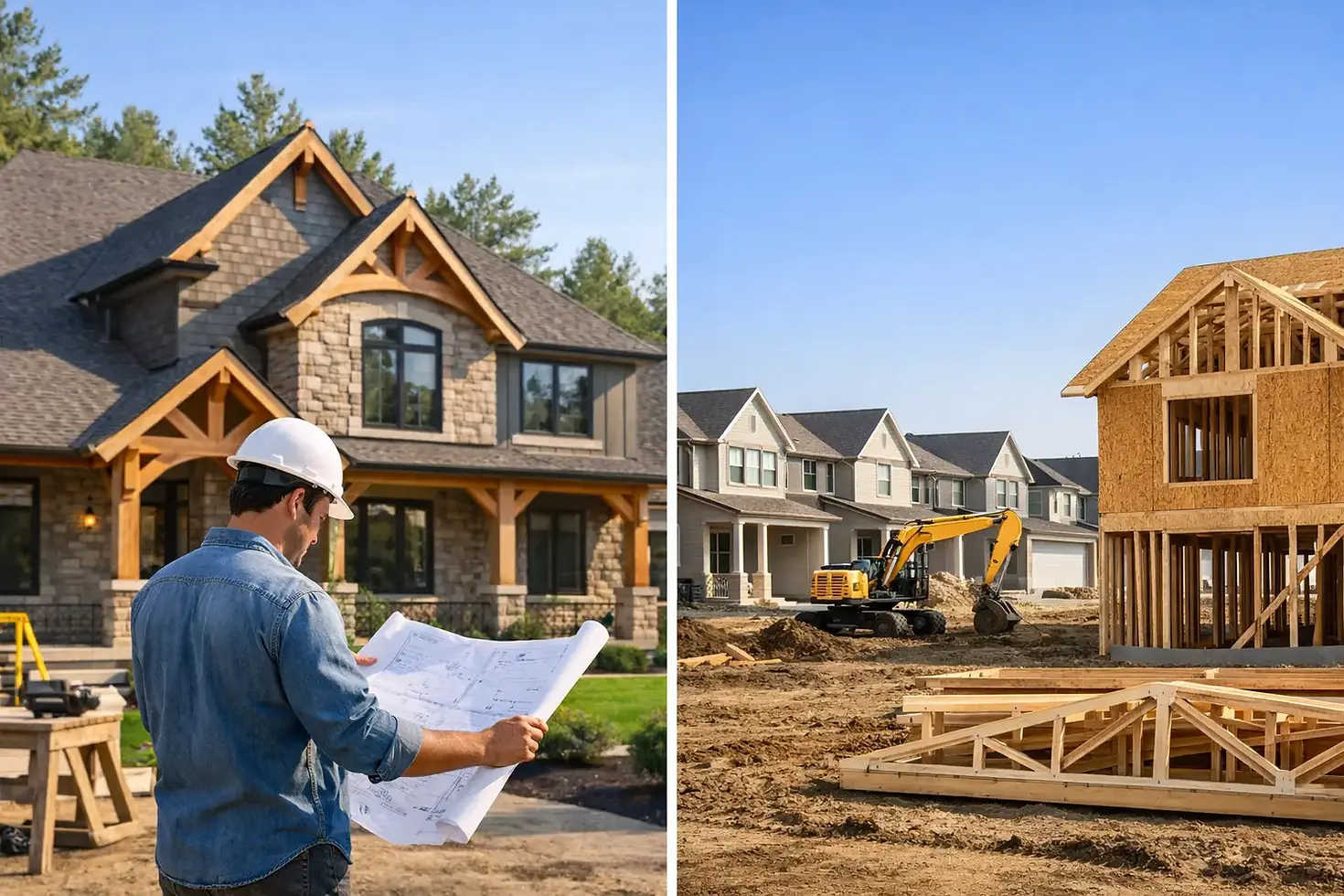
Custom Home Builder Versus Production Builder
- TCI Team

- Apr 11
- 6 min read
A floor plan can look great on paper and still be the wrong fit for how your family actually lives. That is why the choice of custom home builder versus production builder matters so much. Before you compare square footage, finishes, or upgrade packages, it helps to understand how each builder works, where the costs really come from, and what kind of project experience you want.
For many homeowners in Central Massachusetts and MetroWest, this decision comes down to control versus convenience. Both paths can produce a finished home, but they do not offer the same level of flexibility, planning, or accountability. If you are making a long-term investment, the difference is worth understanding early.
Custom home builder versus production builder: the core difference
A production builder typically offers a set library of home models, layouts, elevations, and finish packages. You choose from pre-designed options, often in a planned community or designated build area, and the process is built around efficiency and repeatability. That structure can help with speed and pricing, but it also limits how much you can change.
A custom home builder starts from a different place. The home is built around your lot, your goals, your lifestyle, and your priorities. In a true custom process, the layout, structural details, material selections, and finishes are shaped around your project rather than fitted into a preset template.
That difference affects more than design. It affects budget planning, scheduling, decision-making, communication, and the level of involvement you should expect throughout the project.
When a production builder makes sense
There are situations where a production builder is the practical choice. If you want a new home quickly, prefer a more standardized process, and are comfortable choosing from a menu of approved options, the production route can work well. Many buyers appreciate being able to walk into a model home, choose a plan, and understand the broad outline of the timeline right away.
Production builders also tend to benefit from volume purchasing and repeated systems. Because they build similar homes over and over, they can often streamline labor, materials, and scheduling. That can translate into a lower starting price compared with a custom build.
But homeowners should pay attention to the phrase starting price. The base price may not reflect the final cost once lot premiums, structural options, upgraded finishes, site conditions, and change requests are added. In some cases, buyers begin with a lower advertised number and end up paying significantly more to get the home closer to what they actually wanted.
When a custom home builder is the better fit
A custom home builder is usually the better fit when the home needs to do something specific. Maybe you have a sloped lot, want aging-in-place features, need space for a home office and multigenerational living, or care deeply about natural light, storage, and room flow. Those are not small details. They shape how well the house works for years.
Custom building also makes sense when quality and long-term value matter more than speed alone. Instead of working within a narrow package of preselected choices, you have the opportunity to make decisions that reflect your priorities. That may include better framing details, more durable finishes, improved insulation, a different kitchen layout, or design solutions that fit the property properly.
This is also where the right builder matters. A custom project requires planning discipline, realistic budgeting, and strong coordination between design, permitting, trades, and construction. Homeowners usually want one accountable partner who can manage complexity instead of passing responsibility between separate parties.
Cost is not just about the price per square foot
One of the biggest mistakes homeowners make is comparing custom and production homes only by price per square foot. That number rarely tells the whole story.
Production homes may appear more affordable because many decisions have already been made, and the builder has optimized the process around efficiency. Custom homes often cost more because they involve more individualized design, more detailed planning, and less repetition. Site work can also vary significantly depending on your lot, utilities, grading, drainage, and local permitting requirements.
Still, lower cost up front does not always mean better value. If you end up paying for upgrades to correct layout issues, improve finish quality, or add features that should have been included from the beginning, the price gap can narrow quickly. A well-planned custom project gives you the chance to spend intentionally instead of reactively.
That is why early budgeting matters. Homeowners benefit from a builder who can connect design decisions to real construction costs before the work begins. Clear scope, honest allowances, and practical guidance reduce the risk of budget surprises later.
The design process is where the experience starts to split
The most noticeable difference in custom home builder versus production builder often shows up during design.
With a production builder, you are usually selecting from established plans and predefined options. That can simplify decisions, which some buyers prefer. The trade-off is that your choices happen within guardrails set by the builder's system. If you want to move walls, change window placements, alter the kitchen significantly, or tailor the structure around a unique lot, flexibility may be limited or expensive.
With a custom builder, the process is more collaborative. You can shape the home around how you cook, gather, work, store seasonal items, host family, or move through the house on a daily basis. Done well, this is not about adding complexity for its own sake. It is about solving problems before construction starts.
That planning stage is especially valuable for homeowners who have lived through a renovation, outgrown their current layout, or know exactly what has not worked in past homes.
Speed versus alignment
Production builders usually move faster because the process is standardized. Plans are repeated, selections are structured, and crews are working within familiar systems. If speed is the primary goal, that can be a major advantage.
Custom projects generally take longer, and that is not necessarily a red flag. More design work, more decisions, and more project-specific coordination require time. The question is whether the added time produces a better result for your property and your family.
A faster build is only better if the finished home aligns with what you actually need. If not, the convenience can wear off quickly once you are living with compromises that were locked in early.
Quality control depends on process and accountability
Both production and custom builders can deliver quality work, but quality control looks different in each model.
In a production setting, consistency is the goal. That can be helpful, but it can also mean less attention to individual project nuance. The scale of operations may create distance between the person selling the home, the person managing construction, and the trades completing the work.
In a custom environment, quality often depends on tighter oversight and clearer communication. The advantage is that unusual details, site-specific conditions, and homeowner priorities can be addressed directly rather than treated as exceptions to a standard package.
For that reason, homeowners should look beyond marketing claims and ask practical questions. Who is responsible for communication? How are allowances developed? Who handles permitting coordination? How are changes documented? Is the company licensed and insured? How much experience do they have with projects of similar scope?
Those answers often tell you more than a brochure ever will.
Which option is better for your lot and your goals?
If you are buying in a planned development and want a predictable path to a finished home, a production builder may be the right match. If you own land, want a one-of-a-kind home, or need the design to respond to a specific site or lifestyle, custom is usually the stronger path.
It also depends on how involved you want to be. Some homeowners want a narrower set of choices and a more packaged experience. Others want professional guidance with room to make meaningful decisions. Neither approach is automatically right or wrong. The better choice is the one that fits your priorities, your timeline, and your tolerance for compromise.
For homeowners who value craftsmanship, transparency, and one accountable team from planning through construction, the custom route often provides more confidence. That is especially true for complex homes, high-value investments, and projects where layout, finish level, and long-term performance matter.
A firm like TCI Construction is built around that kind of process - helping homeowners move from vision to finished home with clear planning, budgeting guidance, permitting coordination, and professional construction under one roof.
What to ask before you choose
Before you commit to either path, step back and ask a few honest questions. Are you trying to get into a new home quickly, or are you trying to build the right home for the next 10 to 20 years? Are you comfortable choosing from set options, or do you want the layout and details shaped around your daily life? Is your lot straightforward, or will it require thoughtful planning and problem-solving?
The answers usually point in one direction.
A home is too significant an investment to choose a building path based only on a headline price or a model home first impression. The better decision comes from understanding how the process works, where the compromises live, and who will be accountable when questions come up. Choose the builder model that fits not just your budget, but the way you want to live when the work is done.


Comments